
Impact of Calprotectin on Bacterial Physiology
Ongoing collaborative studies with Dr. Elizabeth Nolan’s laboratory at MIT have examined the impact of calprotectin (CP) on P. aeruginosa iron homeostasis. Originally identified as the “CF antigen” due to its abundance in the lungs of CF patients, CP makes up >40% of the soluble protein in circulating neutrophils. When released from neutrophils, CP binds to several divalent transition metal ions, including zinc, manganese, and nickel to hinder microbial growth. In 2016, the Nolan laboratory made the landmark discovery that CP also bound to the reduced, ferrous form of iron. Subsequent work in collaboration with our laboratory demonstrated that CP induces a robust iron starvation response in P. aeruginosa. Collaborative work in the Nolan and Oglesby laboratories aims to determine how CP-dependent sequestration of multiple metal ions, including iron, affects the physiology and virulence trait expression by P. aeruginosa.
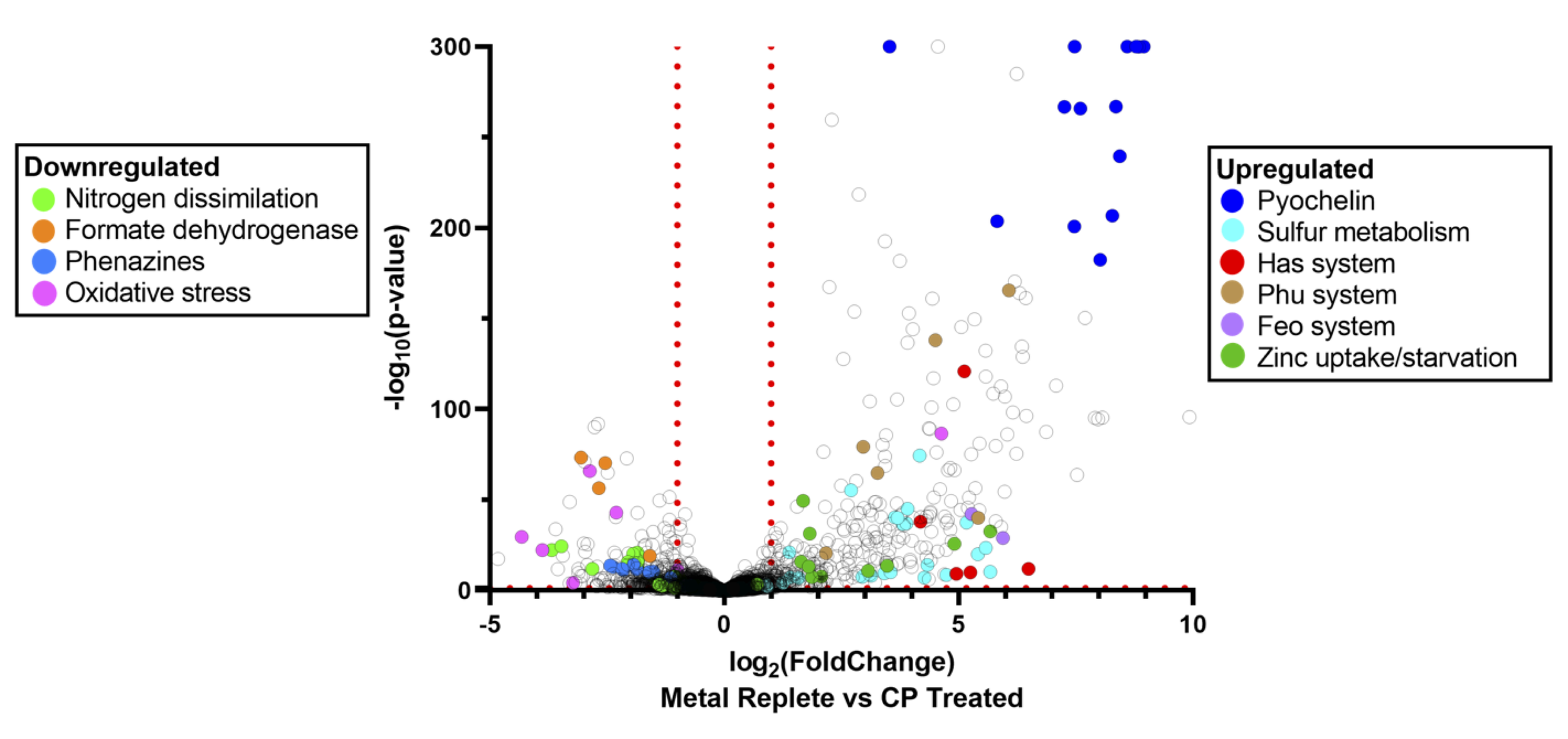
Anaerobic CP treatment induces an aberrant metal starvation response in P. aerugionsa. Weiner, et al, 2025
Representative Publications
Lee WH, Oglesby AG, Nolan EM. (2025) Calprotectin protects Staphylococcus aureus in coculture with Pseudomonas aeruginosa by attenuating quorum sensing and decreasing the production of pseudomonal antimicrobials. mSystems e0057625.
Lee WH, Zygiel EM, Lee CH, Oglesby AG, Nolan EM. (2025) Calprotectin-mediated survival of Staphylococcus aureus in coculture with Pseudomonas aeruginosa occurs without nutrient metal sequestration. mBio e0384624.
Weiner JM, Lee WH, Nolan EM, Oglesby AG. (2025) Calprotectin elicits aberrant iron starvation responses in Pseudomonas aeruginosa under anaerobic conditions. J Bacteriol e0002925.